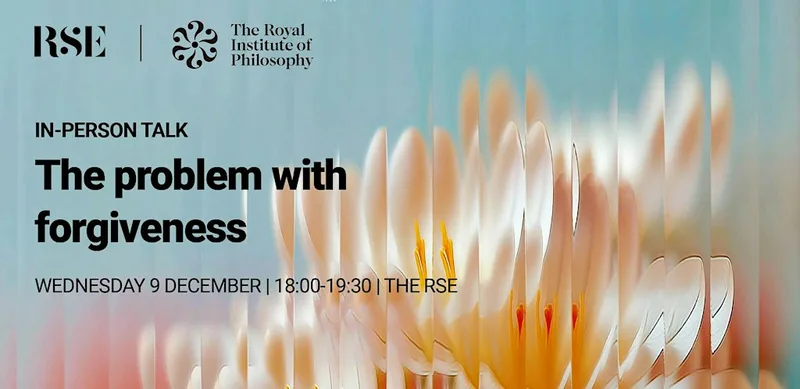
The problem with forgiveness | In-person
Wed 9 Dec · 18:00
The Royal Society Of Edinburgh
Venue events →
Ask AI: is it for me?
Similar events
View allNot quite it? Try these
See all Sun, 22 Nov 2026
The People's Emergency Briefing
Free Entry
 Sat, 28 Nov 2026
Science and Religion: Lived and Imagined Realities
£15
 Sun, 22 Nov 2026
Information Lecture:Help & Healing on the SpiritualPath-BY PHONE
 Thu, 19 Nov 2026
Mason Institute Event - Paul Reid KC seminar
Free Entry
 Thu, 19 Nov 2026
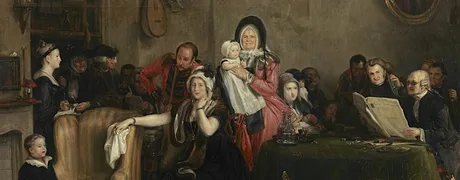
David Wilkie: Creating a Catalogue Raisonné : Panel Discussion
Free Entry
About This Event
The event will focus on understanding the nature and ethics of forgiveness as part of a partnership between the Royal Society of Edinburgh and The Royal Institute of Philosophy.
The RSE's 2026 partnership event with The Royal Institute of Philosophy will focus on understanding the nature and the ethics of forgiveness
Forgiveness can be psychologically and emotionally hard - sometimes it can feel almost impossible. But forgiveness also raises some surprisingly tricky philosophical questions.
Forgiving involves letting go of blame and the hostile feelings that come with it, while still believing that the person was at fault. But this makes forgiveness seem paradoxical: If someone is blameworthy for a wrong, it is rational to blame them. And if they aren’t, what is there to forgive?
And, while forgiveness is something that we can try to earn, it’s not something we can demand. Sincere repentance and making amends may give us good reasons to forgive, but the act of forgiving is often seen as a choice – something we can do freely even when the wrongdoer hasn’t shown any remorse. But, is it right to forgive someone who hasn’t apologised or owned up to what they’ve done? And is it right not to forgive someone who has?
In this talk, Professor Maria Alvarez explores what forgiveness really means, whether it can be owed to another, and whether it can be right to forgive unrepentant wrongdoers.
The event will include a panel of experts who, alongside Maria and the event Chair, will discuss the subject further before opening the Q&A to the Audience.
Speaker: Professor Maria Alvarez
Professor of Philosophy, King's College London
Maria Alvarez is a Professor of Philosophy at King’s College London. Before joining King’s, she was a lecturer at the University of Southampton, having previously taught at the Universities of Oxford and Reading.
Her philosophical interests ranges over questions about human agency, moral responsibility, freedom, reasons, and ethics. She has published on those topics in journals and collections and her book Kinds of Reasons: An Essay in the Philosophy of Action was published by Oxford University Press in 2010. She is currently working on the relationship between agency, choice and moral responsibility.
She is co-Editor of Philosophy, the journal of the Royal Institute of Philosophy.
PANELLIST: Professor Matthew Chrisman FRSE
Professor of Ethics and Epistemology, University of Edinburgh
Matthew is a professor of philosophy at the University of Edinburgh, where my teaching and research have focused on ethics, epistemology, language and politics. He is principally interested in using the language of norms and values to discuss how to live and what to believe. He also maintains a keen interest in the history of philosophical answers to these questions, as well as the contemporary social/political role of the various linguistic manifestations of disagreement, debate, discussion, and protest. He has published several monographs and textbooks on these topics, as well as many articles, teaching resources, and pieces in the popular media. He was a member of the Young Academy of Scotland and is a founding director of the Centre for Responsible Debate.
PANELLIST: Dr Louise Kennefick
Senior Lecturer in Criminal Law, University of Glasgow
Louise Kennefick is a Senior Lecturer in Criminal Law at the University of Glasgow. A qualified solicitor in England and Wales, she completed her PhD on criminal responsibility at University College Cork in 2011. Her research spans criminal law theory, criminal justice and criminology, with a particular focus on blame, condemnation and criminal responsibility. She also examines community supervision and probation through qualitative, stakeholder-centred research. Louise has received funding and awards from the Royal Society of Edinburgh, the Society of Legal Scholars, the Irish Research Council, the European COST Network and the Irish Department of Justice. Her monograph, The Boundaries of Blame: Towards a Universal Partial Defence for the Criminal Law, was published by Cambridge University Press in 2025.
CHAIR: Professor John Gillies OBE FRCGP FRCPE FRSE
Honorary Professor of General Practice, Usher Institute, University of Edinburgh
John is an Edinburgh medical graduate. He worked in Malawi, then as a rural GP, educator and academic in Scotland. After completing an MA in Ethics & Law, I served on the RCGP Ethics Committee for 4 years. He was Chair of RCGP (Scotland) and published on rural health and health policy. He is a co-director of the Global Compassion and Empathy Initiative (GCEI) of the University of Edinburgh. This year, he partnered with the Empathy Place, based at the Edinburgh Veterinary School, on a successful Compassion and Empathy in One Health conference.
Important points to note
This event is suitable for ages 16+
Sensitive content - Please note that this event will include discussion of forgiveness, which implies discussing wrongdoing, and illustrations with examples that may be distressing or controversial. Also, the issues may resonate with people’s experiences in ways that are painful.
Privacy policy: Please note that
Description supplied by the event organiser.
Staying overnight?
Hotels within walking distance of The Royal Society Of Edinburgh.
Ad · Stay22 affiliate link
Similar Events in Edinburgh
View all →Sun, 22 Nov 2026
The People's Emergency Briefing
Augustine United Church
Free Entry
Sat, 28 Nov 2026
Science and Religion: Lived and Imagined Realities
Augustine United Church
£15
Sun, 22 Nov 2026
Information Lecture:Help & Healing on the SpiritualPath-BY PHONE
To Be Confirmed, Edinburgh
Thu, 19 Nov 2026
Mason Institute Event - Paul Reid KC seminar
Lister Learning and Teaching Centre
Free Entry
Thu, 19 Nov 2026
David Wilkie: Creating a Catalogue Raisonné : Panel Discussion
The Fine Art Society
Free Entry

Thu, 19 Nov 2026
A Drunk Man Looks at the Thistle
National Library of Scotland
£0.00
More at The Royal Society Of Edinburgh
View all →
Frequently asked questions
The problem with forgiveness | In-person takes place on Wednesday, 9 December 2026 at 18:00.
The problem with forgiveness | In-person is held at The Royal Society Of Edinburgh in Edinburgh (22-26 George Street, Edinburgh, EH2 2PQ).
Entry to The problem with forgiveness | In-person is free.
Yes — hotels within walking distance of The Royal Society Of Edinburgh can be compared using the accommodation search further down this page.
Tickets for The problem with forgiveness | In-person can be booked via Eventbrite using the "Check Tickets & Live Prices" button on this page, which opens the official booking site in a new tab.
Editorial summaryAbout this event
The event will focus on understanding the nature and ethics of forgiveness as part of a partnership between the Royal Society of Edinburgh and The Royal Institute of Philosophy.
This summary was automatically generated from event data sourced from official ticketing providers.
The RSE's 2026 partnership event with The Royal Institute of Philosophy will focus on understanding the nature and the ethics of forgiveness
Forgiveness can be psychologically and emotionally hard - sometimes it can feel almost impossible. But forgiveness also raises some surprisingly tricky philosophical questions.
Forgiving involves letting go of blame and the hostile feelings that come with it, while still believing that the person was at fault. But this makes forgiveness seem paradoxical: If someone is blameworthy for a wrong, it is rational to blame them. And if they aren’t, what is there to forgive?
And, while forgiveness is something that we can try to earn, it’s not something we can demand. Sincere repentance and making amends may give us good reasons to forgive, but the act of forgiving is often seen as a choice – something we can do freely even when the wrongdoer hasn’t shown any remorse. But, is it right to forgive someone who hasn’t apologised or owned up to what they’ve done? And is it right not to forgive someone who has?
In this talk, Professor Maria Alvarez explores what forgiveness really means, whether it can be owed to another, and whether it can be right to forgive unrepentant wrongdoers.
The event will include a panel of experts who, alongside Maria and the event Chair, will discuss the subject further before opening the Q&A to the Audience.
Speaker: Professor Maria Alvarez
Professor of Philosophy, King's College London
Maria Alvarez is a Professor of Philosophy at King’s College London. Before joining King’s, she was a lecturer at the University of Southampton, having previously taught at the Universities of Oxford and Reading.
Her philosophical interests ranges over questions about human agency, moral responsibility, freedom, reasons, and ethics. She has published on those topics in journals and collections and her book Kinds of Reasons: An Essay in the Philosophy of Action was published by Oxford University Press in 2010. She is currently working on the relationship between agency, choice and moral responsibility.
She is co-Editor of Philosophy, the journal of the Royal Institute of Philosophy.
PANELLIST: Professor Matthew Chrisman FRSE
Professor of Ethics and Epistemology, University of Edinburgh
Matthew is a professor of philosophy at the University of Edinburgh, where my teaching and research have focused on ethics, epistemology, language and politics. He is principally interested in using the language of norms and values to discuss how to live and what to believe. He also maintains a keen interest in the history of philosophical answers to these questions, as well as the contemporary social/political role of the various linguistic manifestations of disagreement, debate, discussion, and protest. He has published several monographs and textbooks on these topics, as well as many articles, teaching resources, and pieces in the popular media. He was a member of the Young Academy of Scotland and is a founding director of the Centre for Responsible Debate.
PANELLIST: Dr Louise Kennefick
Senior Lecturer in Criminal Law, University of Glasgow
Louise Kennefick is a Senior Lecturer in Criminal Law at the University of Glasgow. A qualified solicitor in England and Wales, she completed her PhD on criminal responsibility at University College Cork in 2011. Her research spans criminal law theory, criminal justice and criminology, with a particular focus on blame, condemnation and criminal responsibility. She also examines community supervision and probation through qualitative, stakeholder-centred research. Louise has received funding and awards from the Royal Society of Edinburgh, the Society of Legal Scholars, the Irish Research Council, the European COST Network and the Irish Department of Justice. Her monograph, The Boundaries of Blame: Towards a Universal Partial Defence for the Criminal Law, was published by Cambridge University Press in 2025.
CHAIR: Professor John Gillies OBE FRCGP FRCPE FRSE
Honorary Professor of General Practice, Usher Institute, University of Edinburgh
John is an Edinburgh medical graduate. He worked in Malawi, then as a rural GP, educator and academic in Scotland. After completing an MA in Ethics & Law, I served on the RCGP Ethics Committee for 4 years. He was Chair of RCGP (Scotland) and published on rural health and health policy. He is a co-director of the Global Compassion and Empathy Initiative (GCEI) of the University of Edinburgh. This year, he partnered with the Empathy Place, based at the Edinburgh Veterinary School, on a successful Compassion and Empathy in One Health conference.
Important points to note
This event is suitable for ages 16+
Sensitive content - Please note that this event will include discussion of forgiveness, which implies discussing wrongdoing, and illustrations with examples that may be distressing or controversial. Also, the issues may resonate with people’s experiences in ways that are painful.
Privacy policy: Please note that
Description supplied by the event organiser.
StayStaying overnight?
Hotels within walking distance of The Royal Society Of Edinburgh. Searching near 22-26 George Street, Edinburgh, EH2 2PQ; check-in Wednesday, 9 December 2026.
Ad · Stay22 affiliate link
WhereThe Royal Society Of Edinburgh
22-26 George Street, Edinburgh, EH2 2PQ
Before you goFrequently asked questions
When is The problem with forgiveness | In-person?
The problem with forgiveness | In-person takes place on Wednesday, 9 December 2026 at 18:00.
Where is The problem with forgiveness | In-person taking place?
The problem with forgiveness | In-person is held at The Royal Society Of Edinburgh in Edinburgh (22-26 George Street, Edinburgh, EH2 2PQ).
How much are tickets for The problem with forgiveness | In-person?
Entry to The problem with forgiveness | In-person is free.
Is there anywhere to stay near The problem with forgiveness | In-person?
Yes — hotels within walking distance of The Royal Society Of Edinburgh can be compared using the accommodation search further down this page.
How do I get tickets for The problem with forgiveness | In-person?
Tickets for The problem with forgiveness | In-person can be booked via Eventbrite using the "Check Tickets & Live Prices" button on this page, which opens the official booking site in a new tab.
Price
Free Entry
Date
Time
Venue
22-26 George Street, Edinburgh, EH2 2PQ
Secure checkout on Eventbrite — opens in a new tab
Ask AI: is it for me?
EventsList lists 212,000+ events across the UK. Tickets are sold by the venue or its authorised sellers, never by us.
Same venueMore at The Royal Society Of Edinburgh
All at this venueNot this one?Similar events in Edinburgh
View all



More things to do in Edinburgh
- Rethinking Work in the Graeco-Roman WorldTuesday, 12 January 2027
- Flora Johnston: The Berlin Passport OfficeWednesday, 18 November 2026
- boom saloon x A&DS: Learning to See MoreTuesday, 24 November 2026
- boom saloon x A&DS: Who Owns & Uses Space?Monday, 23 November 2026
- John Bright In ConversationFriday, 27 November 2026
- Inside The News with Martin GeisslerThursday, 19 November 2026
- Before the Ice Cream Wars: Organised Crime in Postwar GlasgowMonday, 15 March 2027
- Prehistoric Britain: A Decade of Archaeogenetic ResearchThursday, 15 April 2027
- Understanding Scotland Economy Tracker Briefing - November 2026 InsightsTuesday, 24 November 2026
- War Doctors - In Conversation: SyriaWednesday, 9 December 2026
- December German MeetupTuesday, 8 December 2026
- The Dead Curious Cafe at Tribe PortyThursday, 10 December 2026
- ‘What to wear when you have nothing else on'Monday, 7 December 2026
- Fakty i mity jedzeniowe – dyskusja z Mauriczem - godz. 14:00Saturday, 12 December 2026