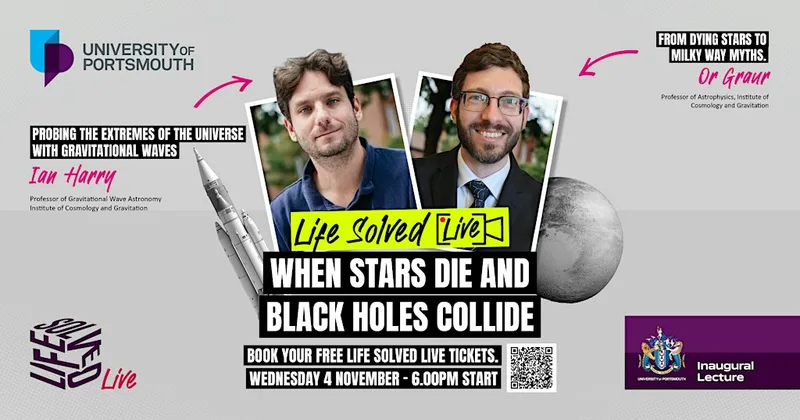
Life Solved Live: When stars die and black holes collide
Ask AI: is it for me?
Similar events
View all →About This Event
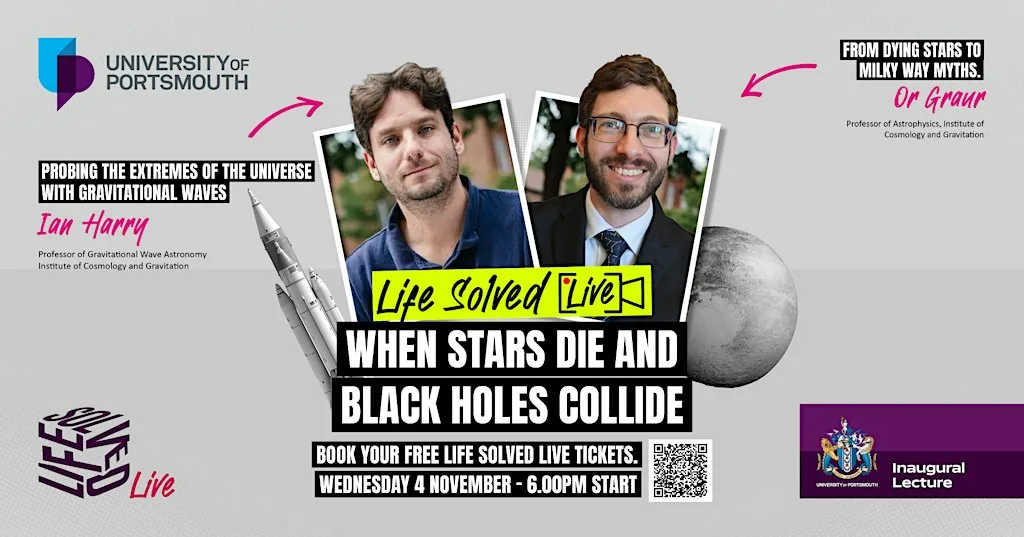
Inaugural Lectures by Professor Or Graur and Professor Ian Harry. Our Universe is full of mysteries. Some of the world leaders in solving those mysteries do so at the University of Portsmouth’s Institute of Cosmology and Gravitation. In this fascinating double bill of talks, two professors share their incredible discoveries. You’ll hear how researchers hunt for signs of tidal disruption events – bursts of light emitted by stars that die by being shredded by supermassive black holes in the centres of galaxies. And you’ll find out how the first observation of gravitational waves a decade ago has revolutionised the science of astronomy. These ripples in the fabric of spacetime allow us to see what happens when black holes and neutron stars collide. This Life Solved Live event is your chance to hear first-hand how researchers are tackling some of the most complex questions in existence – and what drives them to do it. An Inaugural Lecture is one of the most prestigious Life Solved Live events. It’s a celebration of the career of a professor and the difference they make. On 4 November 2026 we present two journeys into space in one evening. In From Dying Stars to Milky Way Myths, Professor of Astrophysics, Or Graur, promises a ‘whirlwind tour’ of his research programme since joining the University of Portsmouth. Professor Graur says: ‘I will start by describing how I use telescopes on Earth and in space to discover and study supernovae – the explosions of stars – and learn which types of stars end up as the different types of supernovae that we observe. ‘Since joining Portsmouth, I have published two popular astronomy books on supernovae and galaxies. The most recent sparked an interest in the multicultural mythology of the Milky Way. In the last part of my talk, I will show how I and members of my group study the conceptualisation of the Milky Way in different cultures, including ancient Egypt and the Arabic-speaking world.’ In Probing the Extremes of the Universe with Gravitational Waves, Professor of Gravitational Wave Astronomy, Ian Harry, will take us inside plans for the next generation of gravitational wave astronomy: massive 50km long detectors on Earth and novel space-based observatories. Professor Harry says: ‘These future instruments will allow us to probe the earliest moments of the Universe, test how matter behaves in the most extreme situations, and uncover the origins of the supermassive black holes at the centres of galaxies. ‘My research group in Prtsmouth focuses both on observing and understanding the black hole collisions detected today and developing the new analysis techniques needed for these future observatories. In this talk, I will discuss the past, present, and future of gravitational-wave astronomy – and Portsmouth's leading contribution within this expanding field.’ Don’t miss this unique double bill of awe-inspiring talks. To book your FREE tickets, select how many you want, then click the ‘Reserve a spot’ button. Keen to hear more about world-changing research and the amazing people who do it? The Life Solved podcast has shared well over 100 stories to date.Listen now (https://www.port.ac.uk/news-events-and-blogs/podcasts/life-solved).
Staying overnight?
Hotels within walking distance of Portland Building.
Ad · Stay22 affiliate link
Similar Events in Portsmouth
View all → From £13.50
The Psychology of Carl Jung
Wed, 21 Oct 2026
The Gaiety Southsea
 Free Entry
Preparing for the Sexual Harassment Law Changes
Wed, 7 Oct 2026
Shaping Portsmouth
 Free Entry
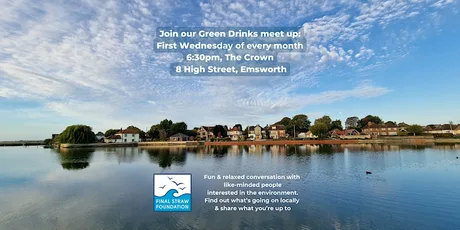
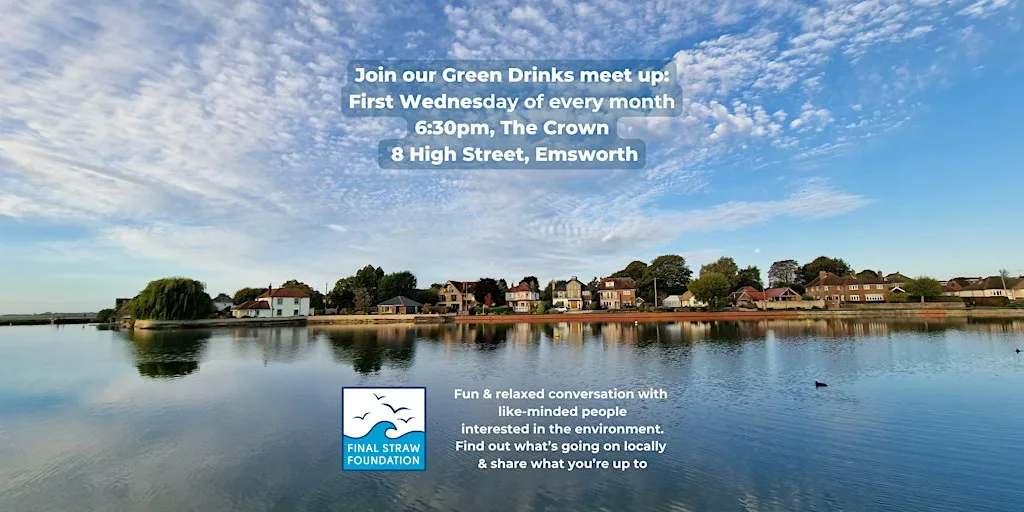
Green Drinks and Project Portunus update
Wed, 7 Oct 2026
The Crown Inn Emsworth
 £2
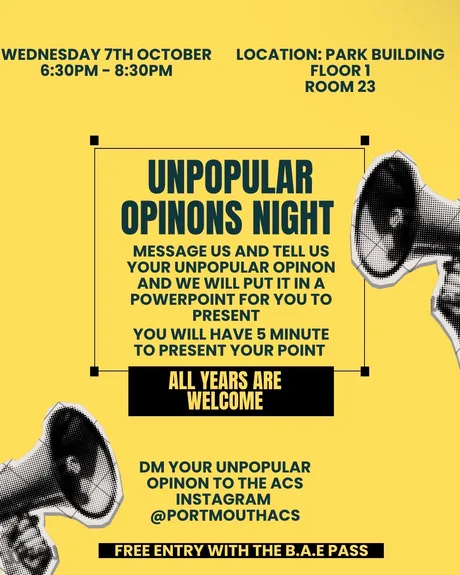
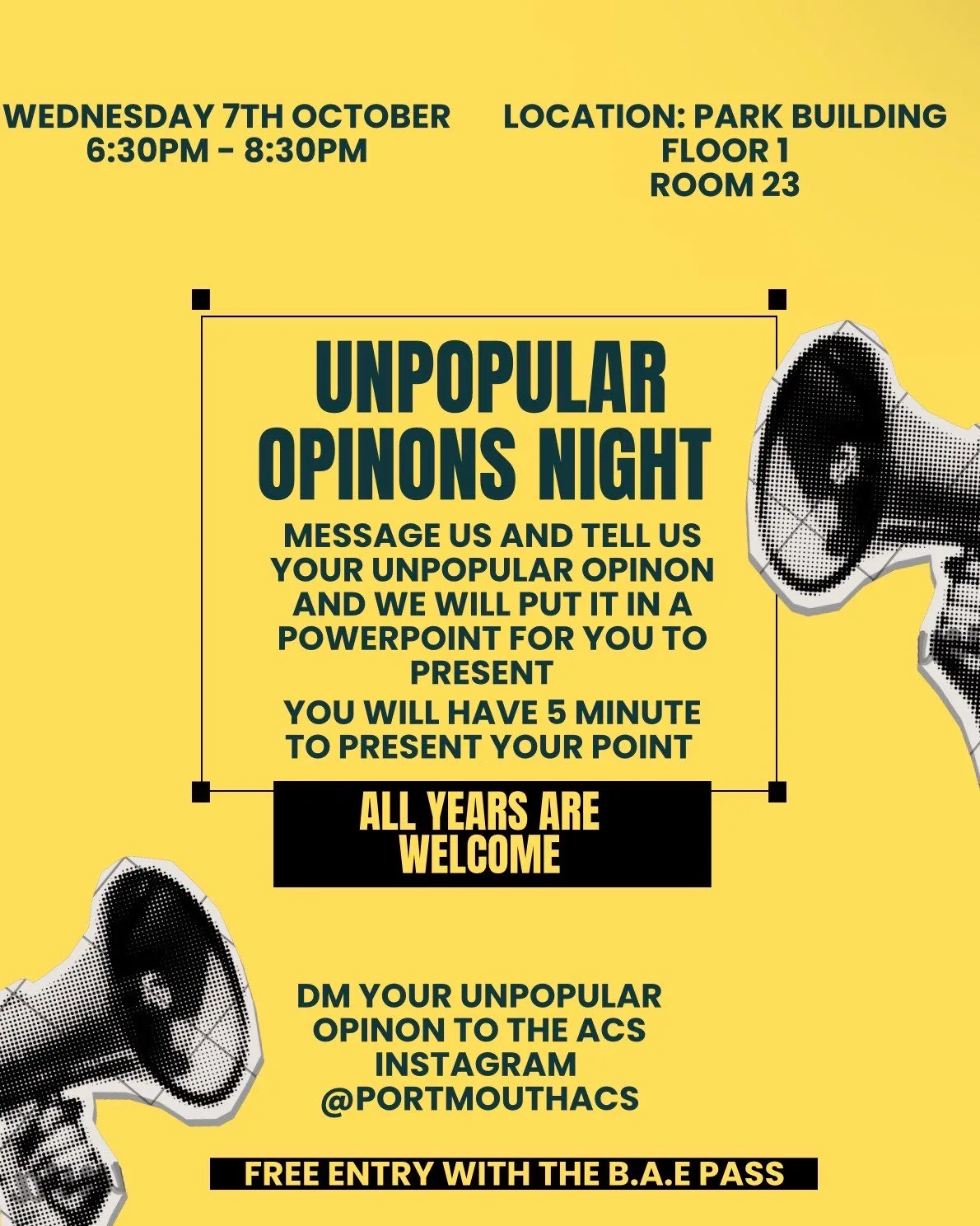
£2ACS Unpopular Opinions Night
Wed, 7 Oct 2026
Park Building
 Free Entry
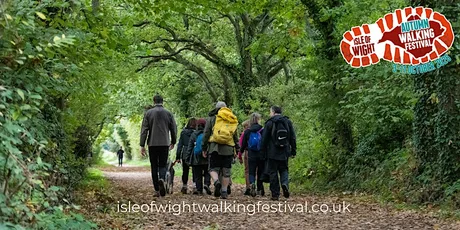
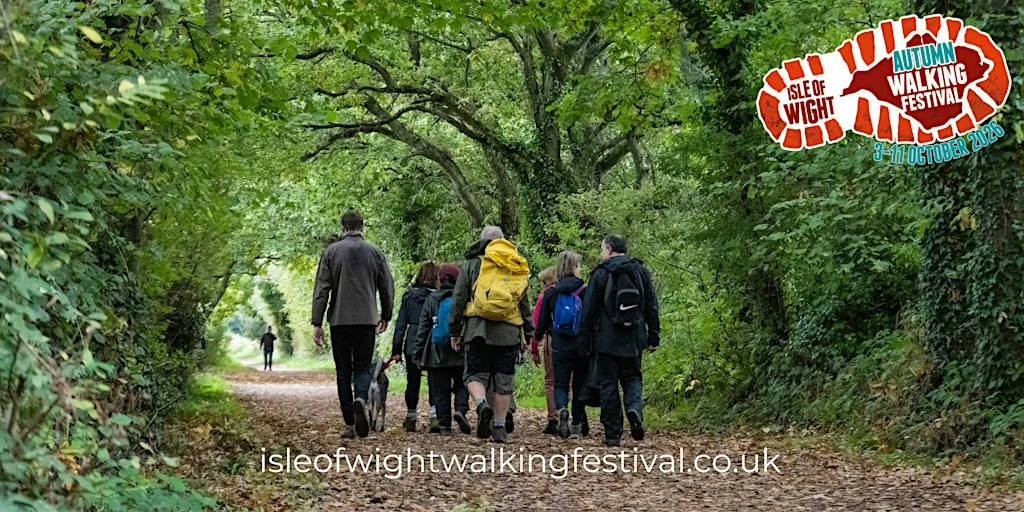
Newchurch Squirrel walk with anecdotal local history thrown in (5 Miles)
Fri, 9 Oct 2026
Newchurch Car Park

Isle of Wight Society Monthly Talk
Mon, 12 Oct 2026
The Riverside Centre
Frequently asked questions
Life Solved Live: When stars die and black holes collide takes place on Wednesday, 4 November 2026 at 18:00.
Life Solved Live: When stars die and black holes collide is held at Portland Building in Portsmouth (Portland Street, Portsmouth, PO1 3AH).
Entry to Life Solved Live: When stars die and black holes collide is free.
Yes — hotels within walking distance of Portland Building can be compared using the accommodation search further down this page.
Tickets for Life Solved Live: When stars die and black holes collide can be booked via Eventbrite using the "Check Tickets & Live Prices" button on this page, which opens the official booking site in a new tab.
Life Solved Live: When stars die and black holes collide
About This Event
Inaugural Lectures by Professor Or Graur and Professor Ian Harry.
Our Universe is full of mysteries. Some of the world leaders in solving those mysteries do so at the University of Portsmouth’s Institute of Cosmology and Gravitation. In this fascinating double bill of talks, two professors share their incredible discoveries.
You’ll hear how researchers hunt for signs of tidal disruption events – bursts of light emitted by stars that die by being shredded by supermassive black holes in the centres of galaxies.
And you’ll find out how the first observation of gravitational waves a decade ago has revolutionised the science of astronomy. These ripples in the fabric of spacetime allow us to see what happens when black holes and neutron stars collide.
This Life Solved Live event is your chance to hear first-hand how researchers are tackling some of the most complex questions in existence – and what drives them to do it.
An Inaugural Lecture is one of the most prestigious Life Solved Live events. It’s a celebration of the career of a professor and the difference they make.
On 4 November 2026 we present two journeys into space in one evening.
In From Dying Stars to Milky Way Myths, Professor of Astrophysics, Or Graur, promises a ‘whirlwind tour’ of his research programme since joining the University of Portsmouth.
Professor Graur says:
‘I will start by describing how I use telescopes on Earth and in space to discover and study supernovae – the explosions of stars – and learn which types of stars end up as the different types of supernovae that we observe.
‘Since joining Portsmouth, I have published two popular astronomy books on supernovae and galaxies. The most recent sparked an interest in the multicultural mythology of the Milky Way. In the last part of my talk, I will show how I and members of my group study the conceptualisation of the Milky Way in different cultures, including ancient Egypt and the Arabic-speaking world.’
In Probing the Extremes of the Universe with Gravitational Waves, Professor of Gravitational Wave Astronomy, Ian Harry, will take us inside plans for the next generation of gravitational wave astronomy: massive 50km long detectors on Earth and novel space-based observatories.
Professor Harry says:
‘These future instruments will allow us to probe the earliest moments of the Universe, test how matter behaves in the most extreme situations, and uncover the origins of the supermassive black holes at the centres of galaxies.
‘My research group in Prtsmouth focuses both on observing and understanding the black hole collisions detected today and developing the new analysis techniques needed for these future observatories. In this talk, I will discuss the past, present, and future of gravitational-wave astronomy – and Portsmouth's leading contribution within this expanding field.’
Don’t miss this unique double bill of awe-inspiring talks. To book your FREE tickets, select how many you want, then click the ‘Reserve a spot’ button.
Keen to hear more about world-changing research and the amazing people who do it? The Life Solved podcast has shared well over 100 stories to date.Listen now (https://www.port.ac.uk/news-events-and-blogs/podcasts/life-solved).
📍 Venue
Portland BuildingPortland Street, Portsmouth, PO1 3AH
Charles Dickens, Portsmouth
Get Directions →❓ Frequently asked questions
When is Life Solved Live: When stars die and black holes collide?
Life Solved Live: When stars die and black holes collide takes place on Wednesday, 4 November 2026 at 18:00.
Where is Life Solved Live: When stars die and black holes collide taking place?
Life Solved Live: When stars die and black holes collide is held at Portland Building in Portsmouth (Portland Street, Portsmouth, PO1 3AH).
How much are tickets for Life Solved Live: When stars die and black holes collide?
Entry to Life Solved Live: When stars die and black holes collide is free.
Is there anywhere to stay near Life Solved Live: When stars die and black holes collide?
Yes — hotels within walking distance of Portland Building can be compared using the accommodation search further down this page.
How do I get tickets for Life Solved Live: When stars die and black holes collide?
Tickets for Life Solved Live: When stars die and black holes collide can be booked via Eventbrite using the "Check Tickets & Live Prices" button on this page, which opens the official booking site in a new tab.
🏨 Staying overnight?
Hotels within walking distance of Portland Building
Ad · Stay22 affiliate link
Price
Free Entry
Date
Until Wednesday, 4 November 2026
Time
Secure checkout on Eventbrite — opens in a new tab
Ask AI: is it for me?
More in Portsmouth
EventsList curates 202,000+ events across the UK. Tickets purchased via the venue or authorised sellers only.
Similar Events in Portsmouth
View all →
More things to do in Portsmouth
- Hannah Fry: Come Fry with Me· Friday, 15 October 2027
- An Evening of Trance Mediumship with Colin Flaherty· Saturday, 14 November 2026
- Abdominal pain: symptoms, causes and investigations information event· Tuesday, 10 November 2026
- Portsmouth - an Inclusive Recovery City & Recovery Awards· Tuesday, 10 November 2026
- Touch· Sunday, 15 November 2026
- Green Drinks and Brent Lodge Wildlife· Wednesday, 4 November 2026
- Let’s Talk Gynaecology: Understanding Your Symptoms & Treatment Options· Thursday, 12 November 2026
- Pompey In The Community National Emergency Briefing· Tuesday, 27 October 2026
- Psychosexual Therapy with Let's Talk Hants· Saturday, 14 November 2026
- PhotoTalk: Olufemi Olaiya + Turning the Tide· Thursday, 22 October 2026
- Solent Media and Creative Industries Collaboration· Thursday, 22 October 2026
- Portsmouth Community Schwartz Round - 'Why I volunteer'· Wednesday, 21 October 2026
- Evidence to Practice in Policing: Missing Persons Showcase· Wednesday, 21 October 2026
- An Evening of Psychic Art and Clairvoyance with Angela Mitchell· Saturday, 17 October 2026